
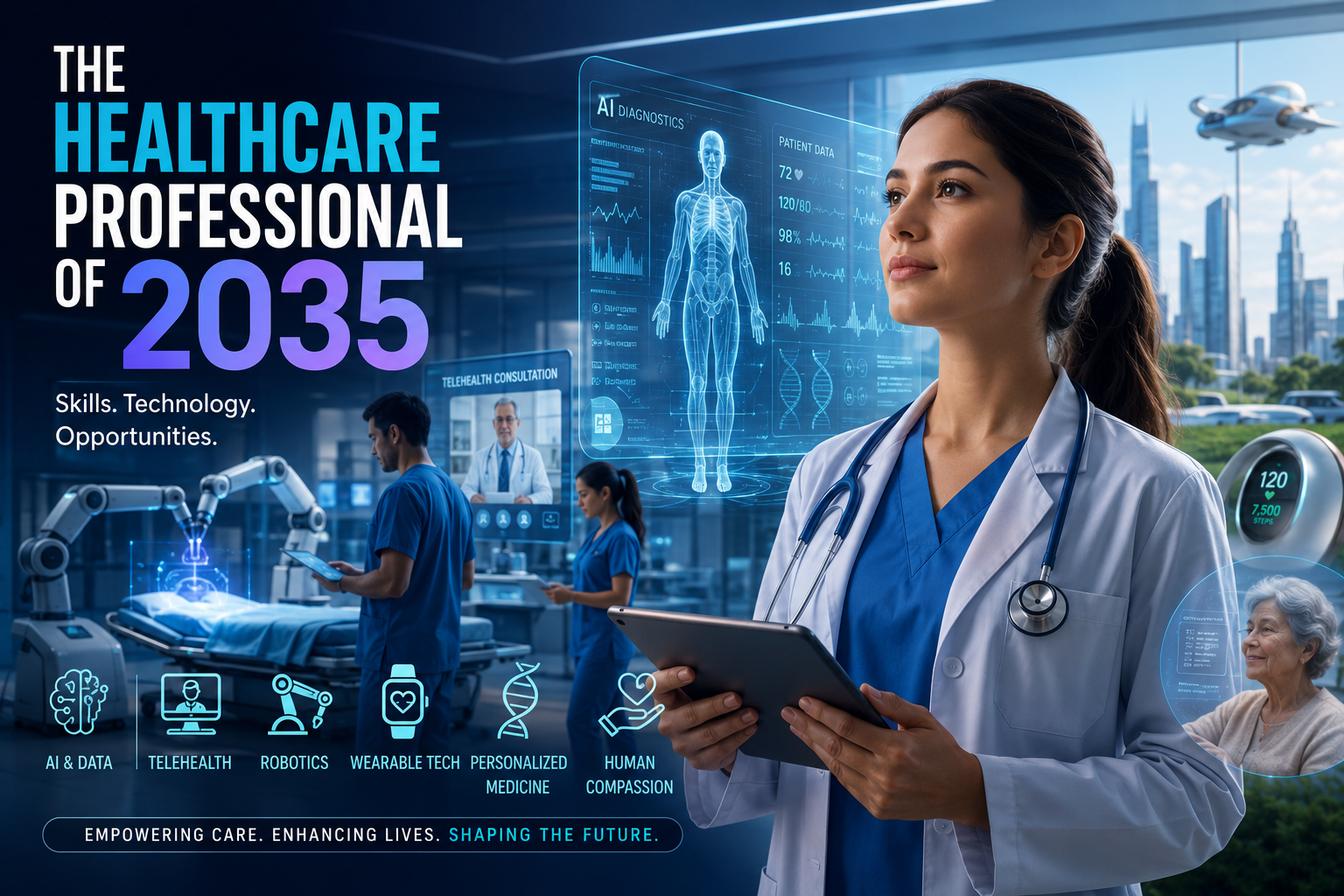
The healthcare industry is evolving faster than ever before. Advances in artificial intelligence, digital health technologies, robotics, and personalized medicine are reshaping how healthcare professionals diagnose, treat, and care for patients. By 2035, healthcare workers will need far more than traditional clinical knowledge. They will be expected to combine technical expertise with digital literacy, adaptability, empathy, and lifelong learning to thrive in an increasingly technology-driven environment.
For students pursuing careers in healthcare today, understanding these future trends is essential. The healthcare professional of 2035 will not be replaced by technology but empowered by it, allowing them to deliver safer, faster, and more personalized care.
The Future of Healthcare Is Already Beginning
Healthcare systems worldwide are experiencing rapid transformation. Electronic health records, telemedicine, wearable health devices, AI-assisted diagnostics, and remote patient monitoring have become increasingly common. These innovations are only the beginning.
By 2035, hospitals and clinics are expected to rely heavily on interconnected digital ecosystems where patient information flows securely across healthcare providers. Artificial intelligence will assist with disease prediction, robotic systems will support surgeries and rehabilitation, and genomic medicine will enable treatments tailored to each patient’s unique genetic profile.
Despite these technological advances, healthcare will remain deeply human. Patients will continue to value compassion, communication, and trust, making healthcare professionals more important than ever.
Essential Skills Every Healthcare Professional Will Need
Digital Health Literacy
Future healthcare professionals must confidently use digital tools in everyday practice. Understanding electronic medical records, digital diagnostics, telehealth platforms, wearable health devices, and healthcare applications will become a basic requirement rather than an optional skill.
Professionals who can efficiently integrate technology into patient care will improve treatment accuracy and workflow efficiency.
Artificial Intelligence Collaboration
Artificial intelligence will become an important clinical assistant rather than a replacement for healthcare workers. AI systems will analyze medical images, identify disease patterns, recommend treatment options, and predict patient risks.
Healthcare professionals must learn how AI works, interpret AI-generated recommendations, recognize its limitations, and combine technological insights with professional judgment.
Data Interpretation
Healthcare organizations will increasingly rely on large amounts of patient data to improve decision-making. Professionals will need to understand healthcare analytics, population health trends, and clinical performance indicators.
The ability to interpret data accurately will support evidence-based practice and improve patient outcomes.
Critical Thinking and Clinical Judgment
Although technology can assist diagnosis and treatment planning, final clinical decisions will always require human expertise. Healthcare professionals must evaluate complex situations, consider patient preferences, identify unusual cases, and make informed decisions that technology alone cannot provide.
Strong analytical thinking will remain one of the most valuable professional skills.
Communication Skills
Technology cannot replace effective communication. Patients often seek reassurance, empathy, and clear explanations during stressful situations.
Healthcare professionals will need excellent communication skills to educate patients, collaborate with multidisciplinary teams, explain complex medical information, and support families during difficult decisions.
Adaptability and Continuous Learning
Medical knowledge continues to expand rapidly. New treatments, technologies, and clinical guidelines emerge every year.
Healthcare professionals of 2035 must embrace lifelong learning through certifications, workshops, online courses, and professional development programs to stay current with industry advancements.
Technologies Shaping Healthcare in 2035
Artificial Intelligence
AI will assist healthcare professionals by detecting diseases earlier, interpreting diagnostic images, predicting patient deterioration, supporting treatment planning, and automating administrative tasks. This will reduce workloads while improving healthcare quality.
Telemedicine and Virtual Care
Remote consultations will become an everyday part of healthcare delivery. Patients living in rural or underserved areas will gain greater access to specialists without traveling long distances.
Healthcare professionals will require skills in virtual communication, remote patient assessment, and digital patient engagement.
Robotics
Medical robots will perform increasingly complex surgical procedures with greater precision. Rehabilitation robots will assist patients recovering from injuries, while service robots may support hospital logistics, medication delivery, and infection control.
Healthcare workers will collaborate closely with robotic systems rather than compete against them.
Wearable Health Technology
Smartwatches, biosensors, and wearable medical devices will continuously monitor heart rate, blood pressure, glucose levels, oxygen saturation, sleep quality, and other vital signs.
Healthcare professionals will analyze this continuous stream of patient data to detect problems before serious complications develop.
Personalized Medicine
Advances in genetics and molecular medicine will allow treatments tailored to each patient’s biological characteristics.
Instead of standardized therapies, healthcare professionals will recommend personalized medications and treatment plans that maximize effectiveness while reducing side effects.
Virtual Reality and Augmented Reality
VR and AR technologies will improve medical education, surgical planning, rehabilitation, pain management, and patient education.
Students may practice complex procedures in realistic virtual environments before treating actual patients.
Career Opportunities in Healthcare by 2035
Healthcare professionals will find opportunities across both traditional and emerging fields.
Clinical practice will continue to expand with increasing demand for physicians, nurses, dentists, pharmacists, physiotherapists, laboratory technologists, radiographers, and public health specialists.
Digital healthcare careers will also grow rapidly, including health informatics specialists, telehealth coordinators, clinical data analysts, AI implementation specialists, medical technology consultants, cybersecurity experts for healthcare systems, and digital health educators.
Preventive healthcare will receive greater attention as healthcare systems focus on reducing disease before it develops. Professionals specializing in nutrition, mental health, community healthcare, wellness coaching, and health promotion will become increasingly valuable.
The Importance of Human Skills
As automation handles repetitive administrative tasks, human-centered skills will become even more valuable.
Empathy enables professionals to build trust with patients during vulnerable moments. Cultural competence ensures respectful care for diverse populations. Ethical decision-making becomes increasingly important as AI influences clinical choices. Leadership and teamwork help healthcare organizations adapt to changing technologies and patient needs.
Healthcare professionals who combine advanced technical knowledge with strong interpersonal skills will be best positioned for success.
Challenges Healthcare Professionals May Face
The healthcare workforce of 2035 will also encounter new challenges. Rapid technological change may require frequent retraining. Protecting patient privacy and cybersecurity will become increasingly important as digital systems expand. Ethical concerns surrounding artificial intelligence, genetic testing, and automated decision-making will require thoughtful professional judgment.
Additionally, healthcare professionals must balance efficiency with compassionate patient care, ensuring that technology enhances rather than replaces meaningful human interaction.
Preparing Today for Tomorrow’s Healthcare Careers
Students can begin preparing now by developing both clinical excellence and digital competence. Learning about artificial intelligence, health informatics, medical technology, and evidence-based practice will provide a strong competitive advantage.
Participating in internships, simulation training, community health programs, research projects, and interdisciplinary collaboration helps build practical experience beyond classroom learning.
Strong communication, professionalism, adaptability, and problem-solving abilities should be developed alongside technical expertise to create a well-rounded healthcare professional.
Conclusion
The healthcare professional of 2035 will work in an environment transformed by artificial intelligence, robotics, digital health platforms, personalized medicine, and continuous data-driven care. While technology will revolutionize healthcare delivery, the core mission of healthcare will remain unchanged: improving lives through compassionate, ethical, and evidence-based patient care.
Students who embrace lifelong learning, develop digital competencies, strengthen critical thinking, and cultivate empathy will be well prepared for the exciting opportunities ahead. The future belongs to healthcare professionals who can successfully combine advanced technology with the uniquely human qualities that patients will always value.