
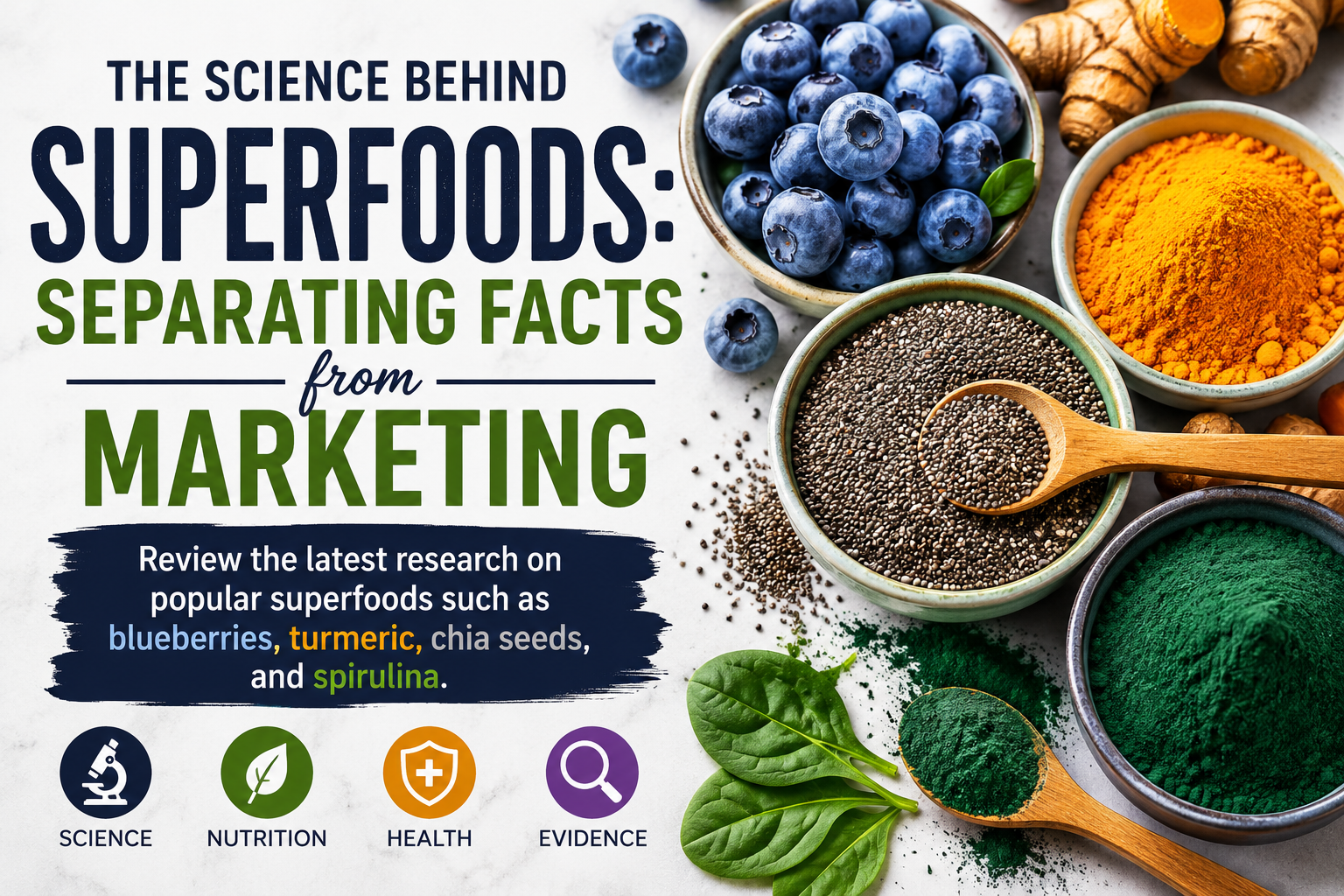
Introduction: Are Superfoods Really Super?


Walk through any grocery store, health-food shop, or social media wellness page, and you’ll encounter the term superfood. From blueberries and turmeric to chia seeds and spirulina, these foods are often marketed as nutritional powerhouses capable of boosting brain health, fighting inflammation, preventing disease, and even extending lifespan.
But what does science actually say?
The truth is that “superfood” is primarily a marketing term rather than a scientific classification. No food possesses magical health properties, and no single ingredient can compensate for an unhealthy overall diet. However, many foods labeled as superfoods do contain high concentrations of beneficial nutrients and bioactive compounds that may contribute to better health when consumed regularly as part of a balanced eating pattern.
This article examines the latest research on four of the world’s most popular superfoods—blueberries, turmeric, chia seeds, and spirulina—to separate evidence-based benefits from exaggerated marketing claims.
What Makes a Food a “Superfood”?
The concept of superfoods emerged largely from food marketing campaigns highlighting foods rich in antioxidants, vitamins, minerals, healthy fats, or phytochemicals.
While there is no official scientific definition, foods commonly labeled as superfoods often contain:
- High antioxidant content
- Anti-inflammatory compounds
- Essential vitamins and minerals
- Dietary fiber
- Beneficial plant compounds (polyphenols)
- Healthy fats
Researchers generally prefer focusing on dietary patterns rather than individual foods because health outcomes depend on overall nutrition rather than a single ingredient.
Still, some foods consistently show promising results in clinical studies.
Blueberries: Tiny Berries With Big Scientific Support


Among all foods marketed as superfoods, blueberries have one of the strongest scientific foundations.
Why Blueberries Are Special
Blueberries are rich in compounds called anthocyanins, pigments responsible for their deep blue color. Anthocyanins belong to a group of plant compounds known as flavonoids, which have potent antioxidant properties.
Researchers believe these compounds help reduce oxidative stress and support vascular and brain health.
Brain Health and Cognitive Function
One of the most exciting areas of blueberry research involves cognitive performance.
Multiple systematic reviews have found evidence that blueberry consumption may improve certain aspects of memory, attention, and cognitive performance, particularly among older adults and individuals experiencing age-related cognitive decline.
Research suggests that regular blueberry intake may:
- Improve short-term memory
- Support learning performance
- Enhance executive function
- Improve mood in some populations
However, scientists caution that findings are not yet strong enough to claim blueberries prevent dementia or Alzheimer’s disease. More long-term human trials are needed.
Heart Health Benefits
Blueberries have also been linked to cardiovascular benefits.
Studies suggest that anthocyanins may help:
- Improve blood vessel function
- Reduce blood pressure
- Improve cholesterol markers
- Reduce inflammation
Population studies consistently associate higher blueberry intake with lower cardiovascular disease risk, though observational studies cannot prove cause and effect.
Marketing vs Reality
Supported by Research
✅ Rich source of antioxidants
✅ May support cognitive function
✅ May improve cardiovascular markers
✅ Nutritious and low in calories
Overhyped Claims
❌ Prevents dementia
❌ Reverses aging
❌ Guarantees weight loss
The evidence is promising, but blueberries are not a miracle cure.
Turmeric: The Anti-Inflammation Superstar


Turmeric has become one of the most heavily marketed health foods worldwide.
Used for centuries in traditional medicine systems, turmeric contains an active compound called curcumin, which is responsible for many of its proposed health effects.
What Research Shows
Curcumin possesses powerful antioxidant and anti-inflammatory properties. Scientists believe it may help regulate inflammatory pathways involved in chronic diseases.
Research has investigated turmeric’s potential role in:
- Osteoarthritis management
- Cardiovascular health
- Metabolic health
- Cognitive function
- Inflammatory disorders
Some studies have demonstrated modest improvements in pain and function among people with osteoarthritis. Other research suggests potential benefits for cardiovascular risk factors and inflammation markers.
The Bioavailability Problem
One major issue often omitted in marketing materials is that curcumin is poorly absorbed by the body.
Researchers estimate that only a small percentage of consumed curcumin enters circulation unless paired with substances that enhance absorption, such as piperine from black pepper. Studies indicate piperine can dramatically increase curcumin absorption.
This means that many advertised benefits observed in supplement studies may not occur simply from sprinkling turmeric on food.
Are Turmeric Supplements Necessary?
Not necessarily.
Most research uses concentrated curcumin doses far higher than those found in typical dietary consumption. Experts generally recommend obtaining turmeric through food first rather than relying on high-dose supplements unless advised by healthcare professionals.
Marketing vs Reality
Supported by Research
✅ Anti-inflammatory properties
✅ Antioxidant activity
✅ Potential support for joint health
✅ May contribute to heart health
Overhyped Claims
❌ Cures cancer
❌ Eliminates chronic disease
❌ Works equally well in everyone
❌ Guarantees major health improvements
Turmeric appears beneficial, but marketing often exaggerates the strength of evidence.
Chia Seeds: Small Seeds Packed With Nutrition


Chia seeds have exploded in popularity due to their impressive nutrient profile.
Originally cultivated by ancient civilizations in Central America, these tiny seeds provide:
- Fiber
- Plant protein
- Omega-3 fatty acids
- Calcium
- Magnesium
- Iron
Fiber: The Real Star
Perhaps the most significant benefit of chia seeds is their fiber content.
Just a small serving provides substantial dietary fiber, which can:
- Improve digestive health
- Promote satiety
- Help regulate blood sugar
- Support cholesterol management
Fiber remains one of the most underconsumed nutrients worldwide, making chia seeds a practical dietary addition.
Cardiometabolic Health
Recent reviews examining overweight individuals suggest chia seed supplementation may provide modest improvements in certain cardiometabolic markers, though results vary considerably among studies. Researchers emphasize that further high-quality trials are needed before drawing firm conclusions.
Potential benefits under investigation include:
- Improved cholesterol levels
- Better blood sugar regulation
- Reduced cardiovascular risk factors
- Enhanced weight management
Weight Loss Claims
One of the most common marketing claims surrounding chia seeds involves rapid weight loss.
Scientific evidence does not support dramatic weight-loss effects.
While fiber-rich foods can increase fullness and potentially reduce calorie intake, chia seeds alone do not produce significant weight loss without broader dietary and lifestyle changes.
Marketing vs Reality
Supported by Research
✅ Excellent fiber source
✅ Rich in omega-3 fats
✅ Nutrient dense
✅ May support heart health
Overhyped Claims
❌ Melts body fat
❌ Causes rapid weight loss
❌ Detoxifies the body
❌ Replaces exercise
Chia seeds are highly nutritious, but they are not a shortcut to weight management.
Spirulina: The Nutrient-Dense Algae


Spirulina may be the most visually distinctive superfood on this list.
This blue-green algae has gained popularity among athletes, wellness enthusiasts, and supplement users due to its exceptionally dense nutritional profile.
Nutritional Highlights
Spirulina contains:
- High-quality protein
- Iron
- B vitamins
- Antioxidants
- Minerals
- Phycocyanin, a unique antioxidant pigment
Its protein content is particularly impressive compared with many plant foods. (Forbes)
What Clinical Research Says
Recent meta-analyses and randomized controlled trials suggest spirulina supplementation may positively influence several health markers. Research has explored its effects on:
- Inflammation
- Body composition
- Cholesterol levels
- Immune function
- Quality of life measures
Some studies report reductions in inflammatory markers such as C-reactive protein and modest improvements in body composition outcomes. However, researchers often classify the overall evidence quality as moderate to low because many studies involve relatively small sample sizes.
Quality Matters
One concern with spirulina involves product quality.
Because spirulina is grown in aquatic environments, contamination with heavy metals, toxins, or other impurities can occur if production standards are poor. Consumers should therefore choose products from reputable manufacturers with third-party testing. (Forbes)
Marketing vs Reality
Supported by Research
✅ Highly nutrient dense
✅ Rich protein source
✅ May reduce inflammation
✅ May improve some metabolic markers
Overhyped Claims
❌ Detoxifies the body
❌ Cures chronic diseases
❌ Dramatically boosts immunity
❌ Provides instant energy
The science is encouraging, but many commercial claims exceed current evidence.
Why Marketing Often Outruns Science
The superfood industry thrives on simplified health messages.
A headline like “Blueberries may modestly improve cognitive function in older adults” attracts less attention than “Blueberries boost your brain.”
This tendency creates several problems:
- Preliminary studies become exaggerated claims.
- Animal research is presented as proven human evidence.
- Supplement benefits are assumed to apply equally to foods.
- Individual foods receive more attention than overall diet quality.
Scientific research progresses gradually, whereas marketing often demands immediate and dramatic conclusions.
The Bigger Picture: Diet Patterns Matter More
Perhaps the most important lesson from superfood research is that no single food determines health outcomes.
People who regularly consume blueberries, turmeric, chia seeds, or spirulina often also engage in other healthy behaviors:
- Eating more fruits and vegetables
- Exercising regularly
- Sleeping adequately
- Avoiding smoking
- Managing stress
These broader lifestyle patterns contribute substantially to health outcomes.
The strongest evidence supports dietary patterns such as the Mediterranean diet, which emphasizes a wide variety of nutrient-rich foods rather than relying on any single superfood. (NCCIH)
Conclusion: Which Superfoods Truly Deserve the Hype?
After reviewing current research, all four featured superfoods possess legitimate nutritional strengths, but none are miracle foods.
Blueberries have some of the strongest evidence, particularly for cognitive and cardiovascular health.
Turmeric shows genuine anti-inflammatory potential, although absorption limitations reduce some real-world effects.
Chia seeds provide exceptional fiber and healthy fats, making them a valuable addition to many diets.
Spirulina offers impressive nutrient density and promising early research on inflammation and metabolic health.
The scientific consensus is clear: these foods can contribute to a healthy lifestyle, but their benefits are best viewed as part of a balanced dietary pattern rather than standalone solutions. The most effective approach is not searching for a single superfood but consistently eating a diverse variety of whole, minimally processed foods.
In the end, the real “superpower” isn’t any individual ingredient—it’s the cumulative effect of healthy habits practiced every day.