
Introduction
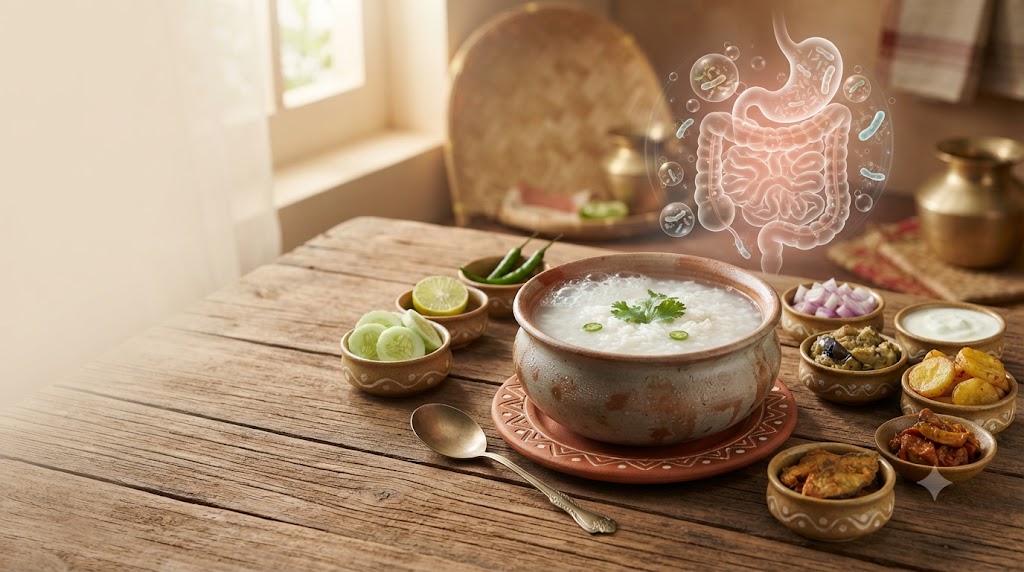
Few traditional foods capture the relationship between culture, climate and nutrition as beautifully as Pakhala Bhata. A familiar part of Odisha’s food heritage, pakhala is prepared from cooked rice and water, with fermentation giving it its characteristic tangy flavor and distinctive texture. It is especially associated with warm weather, when a cool rice-based meal can be refreshing and satisfying.
But there is another reason pakhala has attracted growing interest: gut health. 🦠🌿
Modern nutrition research is increasingly examining fermented foods, the gut microbiome and the effects of food-processing techniques such as cooking and cooling. Research on resistant starch shows that cooking and subsequently cooling rice can increase the amount of starch that resists digestion in the small intestine and reaches the colon, where gut microorganisms can ferment it. (PubMed Central (PMC))
This makes pakhala an interesting meeting point between traditional Indian food practices and modern microbiome research.
However, there is an important scientific distinction. Pakhala should not automatically be called a “probiotic food,” and it should not be promoted as a treatment for diabetes, digestive disease or other medical conditions. The microbial composition of traditionally fermented foods can vary substantially according to ingredients, preparation, temperature, fermentation duration and storage.
So what does science actually tell us?
Let’s explore the traditional preparation of pakhala, the science of fermentation, resistant starch, gut bacteria, digestive health, food safety and how this iconic Odia food can fit into a balanced diet. 🥣🧬


🥣 What Is Pakhala Bhata?
Pakhala Bhata is essentially cooked rice that is combined with water and allowed to undergo fermentation. Depending on the preparation, it may be eaten as simple fermented rice or combined with ingredients such as curd, lemon, salt, green chilli, herbs and traditional tempering.
Different households prepare pakhala differently.
Some preparations emphasize the naturally fermented rice and water, while others use curd or additional ingredients to produce a richer, tangier version.
This diversity is important because there isn’t one standardized microbial or nutritional profile for all pakhala.
The preparation may vary according to:
- Rice variety
- Cooking method
- Amount of water
- Fermentation duration
- Temperature
- Container used
- Use of curd or other ingredients
- Storage conditions
- Accompanying vegetables and protein
These differences mean that one bowl of homemade pakhala cannot necessarily be assumed to have the same microbial characteristics as another.
🌾 Why Does Rice Change During Fermentation?
Fermentation is a biological process in which microorganisms transform components of food.
In many fermented foods, microorganisms metabolize carbohydrates and produce compounds such as organic acids and other metabolites.
These transformations can affect:
🧪 Acidity
👃 Aroma
👅 Taste
🥣 Texture
🦠 Microbial composition
🔬 Chemical composition
In fermented foods generally, researchers have identified several possible mechanisms through which fermentation could influence health, including microbial activity and the production or transformation of bioactive compounds. (PubMed Central (PMC))
Pakhala is therefore more than simply “rice with water.” Once fermentation occurs, the food environment changes.
🦠 Pakhala and the Gut Microbiome
The gut microbiome refers to the enormous community of microorganisms living in the gastrointestinal tract.
These microorganisms interact continuously with the food we eat.
Dietary carbohydrates that escape digestion can reach the colon, where bacteria metabolize them. Some of these processes generate short-chain fatty acids (SCFAs), including:
- Acetate
- Propionate
- Butyrate
SCFAs are important subjects of nutrition research because they interact with intestinal cells and other biological pathways.
Research on resistant starch specifically indicates that microbial fermentation of resistant starch can produce SCFAs and potentially influence intestinal barrier function and other aspects of physiology. (PubMed Central (PMC))
This does not mean that eating pakhala automatically changes someone’s microbiome in a predictable way. Human responses vary, and research specifically on pakhala itself remains much more limited than research on resistant starch and fermented foods generally.
🔬 Fermentation Is Not the Same as Probiotics
This is one of the most important points when discussing pakhala and gut health.
You may see fermented foods described online as “probiotic foods.” Scientifically, however, the term probiotic has a more specific definition.
A fermented food may contain microorganisms without qualifying as a probiotic.
Why?
Because probiotic effects depend on specific microorganisms, adequate amounts and demonstrated health benefits.
Traditional pakhala can contain microorganisms generated or introduced during fermentation, but its microbial population isn’t standardized in the way a commercial probiotic product may be.
The microorganisms present can change according to:
Ingredients → environment → fermentation time → temperature → hygiene → storage
Therefore, it is more scientifically accurate to say that pakhala is a traditional fermented food with potentially interesting microbiological characteristics, rather than automatically labeling it a probiotic treatment.
🍚 The Fascinating Science of Resistant Starch
One of the most interesting connections between pakhala and gut health may involve resistant starch.
Starch is normally broken down into glucose during digestion.
But some starch resists digestion in the small intestine.
This is called resistant starch.
Instead of being completely digested and absorbed in the small intestine, resistant starch can reach the large intestine, where microorganisms can ferment it.
Research reviews identify cooked-and-cooled rice as an important example of a food in which resistant starch type 3 (RS3) can develop through starch retrogradation. (PubMed Central (PMC))
❄️ What Happens When Cooked Rice Cools?
The science is surprisingly interesting.
When rice is cooked, heat and water cause starch granules to swell and change structure.
As the rice cools, some starch molecules can realign and reorganize.
This process is called retrogradation.
Some of the resulting starch becomes more resistant to digestion.
Therefore:
Raw rice → cooking → cooling → starch restructuring → increased resistant starch
The exact amount depends on factors such as rice variety, cooking conditions, water content and cooling/storage conditions.
Research reviews have reported that cooking and cooling can increase resistant starch in rice and other starchy foods. (PubMed Central (PMC))
This provides an interesting scientific perspective on traditional rice dishes that involve cooling before consumption.
🧬 Why Does Resistant Starch Matter?
Resistant starch acts in some ways like a fermentable dietary substrate.
When it reaches the colon, gut microorganisms can metabolize it.
This process can contribute to the production of SCFAs.
🔬 Butyrate
Butyrate is particularly interesting because colon cells can use it as an energy source.
🔬 Acetate
Acetate is one of the most abundant SCFAs produced through microbial fermentation.
🔬 Propionate
Propionate participates in metabolic pathways involving the liver and other tissues.
Researchers are investigating how these metabolites may influence gut barrier function, inflammation and metabolic processes. (PubMed Central (PMC))
But again, this is a mechanistic explanation, not proof that pakhala itself prevents disease.
🌿 Pakhala as a Source of a Broader Dietary Pattern
Another reason pakhala can be nutritionally interesting is that it is rarely eaten alone.
A traditional meal might include:
🥣 Pakhala
🥒 Cucumber
🥬 Vegetables
🌶️ Green chilli
🍋 Lemon
🫘 Dal or other legumes
🐟 Fish
🥛 Curd
🌿 Herbs and spices
The nutritional impact of the meal therefore depends on the entire plate.
For example, plain white rice doesn’t provide large amounts of dietary fiber. But adding vegetables, legumes and other plant foods can substantially improve the meal’s fiber profile.
And fiber is important for the gut microbiome.
🥬 Why Fiber Matters for Gut Health
Dietary fiber provides substrates that some gut microorganisms can ferment.
Different types of fiber are processed differently by the microbiome.
Foods such as:
- Lentils
- Chickpeas
- Beans
- Vegetables
- Fruits
- Whole grains
- Seeds
can contribute different fermentable carbohydrates.
A pakhala meal containing vegetables and legumes can therefore provide a more diverse range of substrates than pakhala alone.
This is an important principle of gut nutrition:
Gut health is influenced by the overall dietary pattern, not one magical food.
🥛 What About Dahi Pakhala?
Dahi Pakhala is another popular variation.
Adding curd introduces a fermented dairy component to the meal.
Depending on the product and preparation, yogurt can contain live cultures.
Fermented dairy foods have been extensively studied in nutrition research, although the specific microorganisms and health effects vary between products.
Dahi pakhala therefore combines two interesting food processes:
Fermented rice + fermented dairy
But it still should not automatically be considered a therapeutic probiotic meal.


☀️ Why Pakhala Is Traditionally Popular in Summer
Odisha’s hot weather provides an obvious cultural explanation for pakhala’s popularity.
A cool, water-rich rice dish can be refreshing during hot days.
The meal can also be relatively simple to prepare and can be paired with seasonal vegetables.
Historically, traditional food cultures often developed in response to local climate, available ingredients and agricultural practices.
Pakhala illustrates this relationship beautifully.
It is:
🌾 Based on a staple grain
💧 Rich in water
☀️ Particularly suitable for hot weather
🦠 Fermented through traditional methods
🥬 Compatible with seasonal vegetables
🍚 Economical and filling
The fact that a food is traditional doesn’t automatically prove a medical benefit—but it can provide valuable clues for nutrition researchers.
❤️ Can Pakhala Be Part of a Heart-Healthy Diet?
Pakhala itself should not be described as a treatment for heart disease.
However, it can fit within a heart-conscious eating pattern.
The key is what accompanies it.
A meal containing:
Pakhala + vegetables + dal + moderate salt + limited fried foods
has a very different nutritional profile from:
Pakhala + several salty pickles + large quantities of fried foods + excessive salt
Salt deserves particular attention.
People with hypertension or other conditions requiring sodium restriction may need to modify traditional recipes.
A nutrition professional can provide individualized guidance when medically necessary.
🩸 Pakhala and Blood Sugar
Rice is a carbohydrate-rich food, so pakhala should not automatically be classified as a low-carbohydrate or diabetes-friendly food.
However, cooling cooked rice can increase resistant starch, and resistant starch may affect the digestion and metabolic response of starchy foods. Research has reported that food-processing conditions can influence resistant starch content and post-meal glucose responses. (PubMed Central (PMC))
But several variables matter:
- Type of rice
- Portion size
- Cooking method
- Cooling conditions
- Fermentation
- Accompanying vegetables
- Protein intake
- Individual metabolism
Therefore, people with diabetes should consider pakhala as part of their overall carbohydrate intake rather than assuming fermentation makes rice “safe” for blood sugar.
🧠 Pakhala and Satiety
Resistant starch and dietary fiber are being investigated for their potential effects on satiety and metabolic regulation.
A meal containing:
🍚 Rice
🥬 Vegetables
🫘 Legumes
🐟 Protein
may be more satisfying than a meal dominated by refined carbohydrates alone.
Again, portion size remains important.
A large serving of rice—even fermented or cooled rice—can still provide substantial carbohydrates.
The goal isn’t to eliminate rice but to build a balanced meal around it.
🌱 Fermented Foods and Modern Nutrition Research
Fermentation is not a new nutritional trend.
Humans have fermented foods for thousands of years.
What is new is our ability to study these processes at a molecular and microbiological level.
Modern researchers can examine:
🦠 Microbial communities
🧬 Microbial genes
🧪 Fermentation metabolites
🔬 Resistant starch
🧫 Organic acids
🧠 Gut-brain interactions
❤️ Metabolic markers
Research on fermented foods suggests that potential effects may arise from several mechanisms—not merely from live microorganisms. Fermentation can alter food components and generate metabolites that interact with the body. (PubMed Central (PMC))
This broader perspective is particularly valuable when examining traditional foods such as pakhala.
🧪 What Scientists Still Don’t Know About Pakhala
There is considerable room for research.
One major limitation is that pakhala itself has not been studied with the same depth as some better-characterized fermented foods.
Future studies could investigate:
1. Microbial composition 🦠
Which bacteria and yeasts are consistently present?
2. Fermentation duration ⏱️
How does microbial composition change after 4, 8, 12 or 24 hours?
3. Rice variety 🌾
Does traditional rice behave differently from polished modern varieties?
4. Resistant starch 🔬
How much RS3 develops under different preparation conditions?
5. Human microbiome response 🧬
Does regular consumption change gut microbial composition or function?
6. Metabolic effects 🩸
Could controlled consumption influence post-meal glucose or other metabolic markers?
7. Food safety 🛡️
What household fermentation practices provide the safest outcomes?
These are fascinating areas for future nutrition and food-science research.
⚠️ Pakhala and Food Safety: An Important Consideration
Traditional does not automatically mean risk-free.
Cooked rice can support the growth of certain microorganisms when it is improperly handled or held for extended periods at unsuitable temperatures.
One important concern is Bacillus cereus.
The U.S. FDA notes that B. cereus is a spore-forming bacterium found in many foods and has been associated with foodborne illness involving improperly handled cooked rice and other foods. (U.S. Food and Drug Administration)
This doesn’t mean people should stop eating pakhala.
It means preparation and storage deserve attention.
Safer practices include:
✔ Start with clean utensils and containers
✔ Use clean, safe water
✔ Avoid contamination during preparation
✔ Don’t leave cooked rice under unsafe conditions for prolonged periods
✔ Refrigerate when appropriate
✔ Avoid consuming food with mold or unusual spoilage
✔ Be especially cautious when serving vulnerable individuals
The FDA Food Code also highlights time, temperature, moisture, water activity and pH as important factors in controlling microbial growth in foods. (U.S. Food and Drug Administration)
🏺 Does an Earthen Pot Make Pakhala Healthier?
Traditional pakhala is sometimes prepared or served in earthen vessels.
Clay pots can influence temperature, moisture and sensory characteristics, and they are an important part of traditional food culture.
However, claims that simply using a clay pot makes pakhala medically superior require evidence.
The important factors for safety remain:
Clean vessel + safe water + appropriate food handling + appropriate storage
The cultural value of traditional utensils is significant, but it should not be confused with proven therapeutic effects.
🧂 Watch the Salt and Fried Accompaniments
Pakhala itself can be relatively simple.
The nutritional balance of the meal can change dramatically through accompaniments.
Traditional sides may include fried vegetables, pickles, spicy preparations or other salty foods.
These can be enjoyed as part of a varied diet, but frequent large portions may increase total:
🧂 Sodium
🛢️ Added fat
🔥 Calories
A health-conscious version can emphasize fresh vegetables, dal, modest portions of fried foods and reasonable salt.
🥒 How to Build a Gut-Friendly Pakhala Plate
A balanced pakhala meal can look like this:
🥣 1. Pakhala
Choose a moderate portion according to your energy and carbohydrate needs.
🥬 2. Vegetables
Add cucumber, leafy vegetables, pumpkin, gourds, tomatoes or other seasonal vegetables.
🫘 3. Protein
Dal, beans, fish, eggs or another suitable protein source can make the meal more balanced.
🥛 4. Fermented food
Curd can be included if it suits your diet.
🌿 5. Herbs and spices
Use traditional herbs and spices for flavor.
🧂 6. Moderate salt
Particularly important for people who have been advised to limit sodium.
🍳 7. Fried foods in moderation
Traditional fried accompaniments can remain part of the meal without becoming its dominant component.
👨👩👧 Who May Need Individual Dietary Advice?
Pakhala is a normal traditional food for many healthy people, but individual dietary requirements vary.
People managing:
- Diabetes
- Kidney disease
- Hypertension
- Gastrointestinal disorders
- Food allergies
- Immune-system disorders
may need individualized advice.
Someone experiencing persistent diarrhea, abdominal pain, unexplained weight loss, vomiting or other digestive symptoms should not rely on fermented foods as a self-treatment.
A persistent digestive problem deserves proper medical evaluation.
🌏 Pakhala in the Context of Traditional Indian Foods
India has an enormous diversity of fermented and traditionally processed foods.
Examples include:
🥣 Idli and dosa batter
🥛 Curd
🥒 Fermented vegetables
🌾 Fermented rice preparations
🫘 Various legume fermentations
🥤 Traditional fermented beverages
These foods demonstrate that fermentation has long been part of Indian culinary traditions.
Pakhala is especially interesting because it combines rice, water, cooling and fermentation, creating a preparation that fits naturally into Odisha’s food culture.
🔬 Traditional Knowledge Meets Modern Science
There is a tendency to describe traditional foods in two extremes.
One extreme says:
“Traditional means automatically healthy.”
The other says:
“Traditional foods have no scientific relevance.”
Both approaches are overly simplistic.
Traditional foods can contain genuinely interesting nutritional properties, while scientific research can determine which claims are supported and which are not.
Pakhala is a perfect example.
Its traditional importance is unquestionable.
Its fermentation is scientifically interesting.
Its cooled rice may contain resistant starch.
Its complete meal can provide carbohydrates, vegetables and protein.
But specific claims about preventing or treating disease still require controlled human evidence.
This balanced approach allows traditional food culture and modern science to complement each other. 🌾🔬
🧬 Pakhala, Resistant Starch and the Microbiome: The Bigger Picture
The potential relationship can be visualized simply:
Cooked rice
⬇️
Cooling
⬇️
Starch retrogradation
⬇️
More resistant starch in some conditions
⬇️
Reaches the colon
⬇️
Microbial fermentation
⬇️
Production of metabolites such as SCFAs
⬇️
Potential effects on intestinal physiology
Research supports the biological plausibility of this pathway, but the magnitude of the effect depends on the food, preparation, dose and individual microbiome. (PubMed Central (PMC))
That final point is crucial.
Not everyone’s gut responds to food in exactly the same way.
🌟 Why Pakhala Deserves More Scientific Attention
Pakhala represents a fascinating research opportunity.
It combines:
🌾 A major staple crop
🦠 Traditional fermentation
❄️ Cooling
🧬 Resistant starch
🥬 Seasonal vegetables
🌿 Traditional spices
☀️ Climate-adapted eating
👨👩👧 Cultural food practices
Researchers could investigate pakhala from the perspectives of food science, microbiology, nutrition, gastroenterology and public health.
This could potentially help answer a broader question:
Can traditional food-processing practices contribute useful nutritional characteristics to modern diets?
That question extends far beyond Odisha.
📚 What Current Evidence Really Says
The evidence can be summarized into several levels.
Stronger evidence
There is substantial scientific evidence that:
- Resistant starch can reach the colon.
- Gut microorganisms can ferment resistant starch.
- Cooking and cooling can increase resistant starch in foods such as rice.
- Fermentation can substantially change food composition. (PubMed Central (PMC))
Promising but context-dependent evidence
Research suggests resistant starch may influence:
- SCFA production
- Gut microbial activity
- Post-meal glucose responses
- Satiety
- Some markers of metabolic health
But effects vary according to dose, food source, microbiome and individual characteristics. (PubMed Central (PMC))
What remains uncertain
There is much less direct evidence showing that regular consumption of traditionally prepared pakhala specifically produces a particular clinical health benefit.
That’s why scientific communication should distinguish between evidence about pakhala itself and evidence about fermented foods or resistant starch more broadly.
🍚 Is Pakhala a “Superfood”?
The answer depends on what we mean by superfood.
If the term means “a traditional food with interesting nutritional characteristics,” pakhala certainly deserves attention.
But if “superfood” means a food proven to prevent disease or dramatically improve gut health, the evidence does not justify such a claim.
A healthier way to think about pakhala is:
Pakhala is a traditional fermented rice preparation that can be part of a balanced diet and offers interesting possibilities for nutrition and microbiome research.
That statement respects both tradition and science.
❤️ Making Traditional Pakhala Part of Modern Healthy Eating
You don’t need to abandon traditional foods to follow modern nutrition principles.
Instead, traditional meals can be adapted thoughtfully.
A modern balanced pakhala plate might emphasize:
🌾 Moderate rice
🥬 Plenty of vegetables
🫘 Adequate protein
🥛 Optional curd
🌿 Traditional spices
🧂 Moderate sodium
🍳 Limited deep-fried accompaniments
💧 Safe water and appropriate food storage
This approach preserves the cultural identity of the dish while supporting broader principles of balanced nutrition.
🌾 Final Conclusion: Pakhala Bhata and the Future of Gut Health Research
Pakhala Bhata is far more than a simple rice dish. It is a reflection of Odisha’s culinary heritage, climate, agricultural traditions and food-processing knowledge. Its fermentation gives it a distinctive character, while the cooling of cooked rice introduces an interesting connection with resistant starch and modern gut-microbiome research.
Scientific studies show that resistant starch can be fermented by gut microorganisms and contribute to the production of metabolites such as short-chain fatty acids. Cooking and cooling can increase resistant starch in rice under appropriate conditions. (PubMed Central (PMC))
Fermented foods more broadly may influence health through microorganisms, fermentation-derived metabolites and changes in food components. (PubMed Central (PMC))
But the scientific story surrounding pakhala specifically is still developing.
It would be premature to claim that pakhala is a cure for digestive problems, diabetes, cholesterol or other diseases. It is equally important not to assume that every bowl has identical probiotic properties.
Instead, pakhala deserves attention as an example of how traditional food practices can intersect with modern nutrition science. 🌾🦠🔬
Its greatest nutritional potential may come not from treating it as a miracle food, but from incorporating it into a diverse diet containing vegetables, legumes, appropriate protein and other fiber-rich foods.
And perhaps that is the most valuable lesson from pakhala:
Traditional foods do not need exaggerated health claims to be scientifically interesting.
Sometimes, a humble bowl of fermented rice can open the door to fascinating questions about starch, microbes, fermentation, culture and human health. 🥣🌿🧬
🌟 Key Takeaways
- 🌾 Pakhala Bhata is a traditional fermented rice preparation strongly associated with Odisha.
- 🦠 Fermentation changes the microbial and chemical characteristics of food.
- ❄️ Cooling cooked rice can increase resistant starch through starch retrogradation.
- 🧬 Resistant starch can reach the colon and be fermented by gut microorganisms.
- 🧪 Microbial fermentation can produce short-chain fatty acids such as acetate, propionate and butyrate.
- 🥬 Vegetables, legumes and protein can make a pakhala meal more nutritionally balanced.
- 🥛 Dahi pakhala adds a fermented dairy component but should not automatically be considered a therapeutic probiotic meal.
- ⚠️ Proper handling and storage of cooked rice are essential because foodborne pathogens such as Bacillus cereus can be associated with improperly handled rice. (U.S. Food and Drug Administration)
- 🔬 More human research specifically examining pakhala is needed.
- ❤️ Pakhala can be part of a balanced diet, but it should not be presented as a treatment for medical conditions.


